Illustrative scenarioFictional dealer group, plan and results. Not an executed AMPS client case or a performance guarantee.
Home / Who we work with / Use case
AMPS use case · Dealer groups

From a capacity gap to a smarter service floor.

A dealer group was turning work away while waiting times kept rising. In this scenario AMPS started by delivering and documenting agreed work. That data became the starting point for process improvement and a targeted robot pilot.

One programme. Delivery today. A route for the long term.
The future bay From service-floor data to a robot pilot Don’t start with the robot. Start with the work. Concept illustration · not a client site
3sites in the fictional group
24bays in total
5milestones, each with a business case
716 hfreed per year in the pilot model
01 / The challenge

Enough work. Not enough capacity.

Dealer Group A · fictional · multi-brand · EV & hybrid

Dealer Group A had three sites and 24 bays. Maintenance slipped, and during the seasonal tyre change wheel work and diagnostics competed for the same bays. Customers waited longer and some work went elsewhere.

AMPS proposed a programme starting at one site: deliver agreed maintenance and wheel-service work, document every step digitally and improve month by month. An AMPS programme lead aligned scope, work allocation and quality checks with the aftersales manager.

“Solve today’s work. Learn how it can work better tomorrow.”
Delivery on the service floorAMPS took on agreed service and wheel work. No separate technology pilot next to an overloaded operation.
Learning from deliveryDigital work orders and selected image and time logging made process steps and recurring disruptions visible.
Improve before investingStandardise the method first. Only then decide whether one well-defined robot task makes sense.
02 / The journey

No leap. A route built on evidence.

Five milestones. Each one starts when the previous one has delivered its outcomes. Select a milestone.

01 / Digitalise Deliver and document. We began at one site with an agreed work package. Each work order recorded task, vehicle category, start and end time, waiting time, checkpoints and photos. 1,200 documented work orders formed the first baseline.
Available today Outcome: an agreed method, digital job records and a process baseline.
Data quality, consent, technical feasibility and partner availability decide when each next milestone starts. We commit to the outcomes and the journey, not to a calendar.
03 / What the data changed

Choose the right task. Not just a robot.

In the baseline, wheel work stood out: repeatable, with recognisable variants and recurring peaks. That made it a better first candidate than complex EV diagnostics or unpredictable repairs.

Data is not robot training. The service-floor data helped choose and specify the task. The robotics partner brings its own sensors, control, calibration and validation.
01CaptureWhat really happens during a work order?
02UnderstandWhere is repetition, waste or variation?
03StandardiseWhich steps can be simplified first?
04AutomateWhich well-defined task fits a validated cell?
04 / The pilot

The robot does the repeatable work. The technician stays in control.

The chosen application: removing and refitting complete wheel sets on a limited number of supported vehicle and wheel combinations. Not an autonomous service floor, one controlled part of the process.
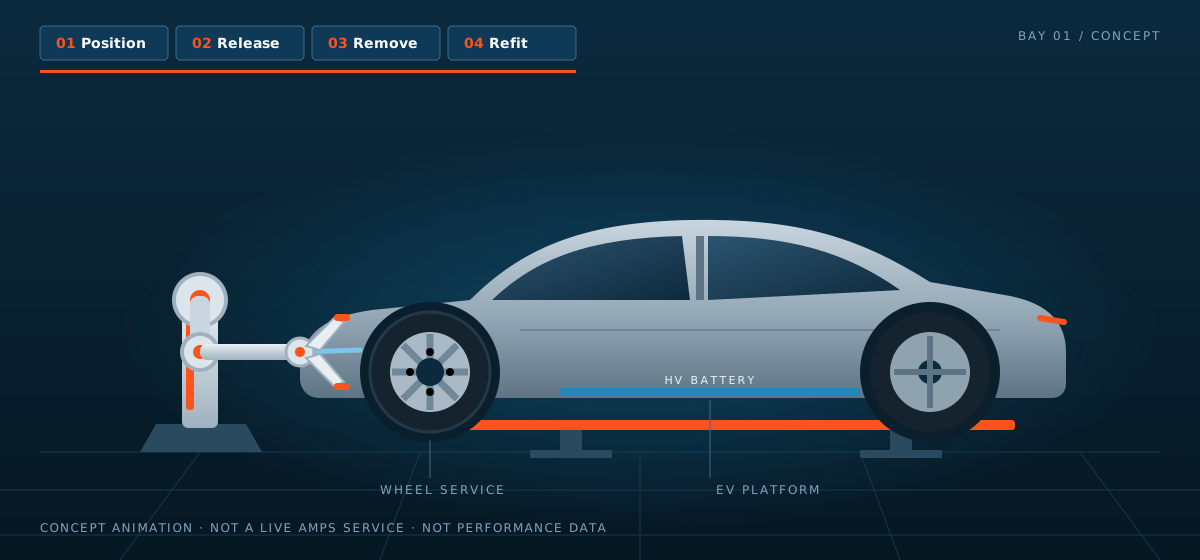
Concept animation of a robot-assisted wheel change on an electric vehicle
01Select & releaseA trained operator confirms that vehicle, wheels and work order are within the validated scope.
02Recognise & handleInside the safeguarded cell, 3D vision supports positioning while the robot handles fastening and wheel handling.
03Check & completeThe operator handles exceptions and performs the final check. The work order gets a digital check record.
05 / The model

The gain is in time. And it grows.

Explicit model assumptions for one pilot site. Not client measurements, supplier claims or promised savings.

Human time per wheel-set change (minutes)
Original process30 min
After standardisation24 min
With robot assistance*10 min
* Only for work orders that follow the robot route. Includes preparation, operation, average interventions and final check.
Process improvement+240 hhours per year, without a robot
Robot assistance+476 hadditional hours per year
Total in the model+716 hhours per year to plan for other work
↗ Value compounds milestone by milestone: first capacity, then process gains, then targeted automation. Freed hours become capacity for work you would otherwise turn away.
A real business case also includes purchase or lease, integration, space, maintenance, training, validation, downtime and the AMPS programme.
The core of the case

Helped today. Better organised tomorrow.

For the operationAgreed work gets done while the service floor keeps running. Scope, allocation and quality stay explicit.
For the customerDigital photos and check records show what was done. Satisfaction and turnaround are measured separately.
For the long termA repeatable method: capture, improve, validate, then scale. Robots are a means, not the starting point.

Where does the next step start on your service floor?

Start with the work that is waiting today. Then decide which data, process improvement and technology really add value.

Configure your programme → Request a programme proposal → Illustrative sales scenario. All dealer data and model results are fictional.
Use Case: From Capacity Gap to a Smarter Service Floor | AMPS
{{ t.banner }}{{ t.bannerTxt }}
Home / Who we work with / Use case
{{ t.kicker }}

{{ t.h1a }} {{ t.h1b }}

{{ t.intro }}

{{ t.trust }}
The future bay {{ t.cardK }} {{ t.cardH }} {{ t.cardF }}
{{ x.a }}{{ x.b }}
{{ t.c1k }}

{{ t.c1h }}

{{ t.c1tag }}

{{ t.c1p1 }}

{{ t.c1p2 }}

“{{ t.c1q }}”
{{ c.a }}{{ c.b }}
{{ t.c2k }}

{{ t.c2h }}

{{ t.c2p }}

{{ cur.n }} / {{ cur.t }} {{ cur.h }} {{ cur.d }}
{{ cur.status }} {{ cur.o }}
{{ t.mileNote }}
{{ t.c3k }}

{{ t.c3h }}

{{ t.c3p }}

{{ t.c3note }}
{{ x.n }}{{ x.t }}{{ x.d }}
{{ t.c4k }}

{{ t.c4h }}

{{ t.c4p }}

Concept animation of a robot-assisted wheel change on an electric vehicle
{{ x.n }}{{ x.t }}{{ x.d }}
{{ t.c5k }}

{{ t.c5h }}

{{ t.c5p }}

{{ t.barsT }}
{{ b.t }}{{ b.v }} min
{{ t.barsNote }}
{{ r.t }}+{{ r.v }} h{{ r.d }}
↗ {{ t.grow }}
{{ t.modelNote }}
{{ t.c6k }}

{{ t.c6h }}

{{ c.t }}{{ c.d }}

{{ t.endH }}

{{ t.endP }}

{{ t.endC1 }} → {{ t.endC2 }} → {{ t.foot }}